

You've studied and studied. You know an enormous amount about your subject. You've got examples, data, research findings or quotations at your fingertips. But when you sit down to write, you can’t work out how to use all that knowledge in a way that showcases your thinking.

Knowing your subject is one thing. Knowing how to turn that knowledge into an argument is another.
Perhaps you've been told that your work is too descriptive, that you need to engage more critically with the literature, or that you haven't developed your argument sufficiently. You understand what those words mean, but you're not entirely sure what you're supposed to do differently.
What's happening in that space between what you know and your ability to demonstrate that you understand it?
I see this problem with clients all the time, from senior high school students right through to doctoral candidates. They're often very knowledgeable about their subjects. But they're struggling to produce the kind of response their teachers, lecturers or supervisors are looking for.
They come to me wanting help to get better at writing - but I think the problem frequently begins before they've written a single word.
A question is an instruction, not just a topic
One of the most common problems I see is students allowing their knowledge to drive their response, rather than the question itself.
They recognise the topic, think about everything they know, and start writing.
But an academic question isn't simply the name of something you're expected to demonstrate your knowledge about. It's an instruction about what you're supposed to do with that knowledge.
And embedded in that instruction are some very important words.
Consider the difference between being asked to identify, describe, explain, analyse or evaluate something.
If you're asked to identify something, you simply need to name it. Describing requires a little more: you need to provide details that show what it is or what happens. When you're asked to explain, you're beginning to deal with how or why something happens.
But analysis requires a different kind of intellectual work. You're examining relationships between ideas, looking for patterns and considering what they mean.
And evaluation asks you to go further again. You need to weigh up what you know, consider the evidence and make a reasoned judgement in the context of the question. Think of it as a progression:
WHAT I KNOW
Research, evidence, examples, ideas
WHAT THE QUESTION ASKS ME TO DO
Interpret the instructions and boundaries
WHAT I WANT TO ARGUE
Develop a position and select relevant evidence
WHAT I NEED TO SHOW MY READER
Make the connections and reasoning explicit

Academic writing isn't simply about demonstrating knowledge. It's about using that knowledge to answer a particular question
It's not quite as simple as saying one instruction word is always harder than another. The complexity of the subject and the question matters too. But understanding what these words ask you to do is fundamental, because the instruction changes what evidence you select, and how you use it.
Of course, academic questions are rarely as tidy as this. You might be asked to identify an issue, explain its causes, compare different perspectives and then evaluate their implications, all in the same assignment. Part of unpacking the question is recognising that these instructions don't necessarily carry equal weight. Some are asking you to establish the groundwork for the more demanding thinking that follows.
Think of your knowledge as a wardrobe
When I'm working with a student, one of the things we'll often do is take a paragraph they've already written and look at what each sentence is actually doing. Is it making a claim? Presenting evidence? Explaining the significance of that evidence? Very often, we discover that the student has plenty of material, but hasn't yet made the connections visible to their reader.
Here's an analogy I use with students.
Imagine your wardrobe, with all your clothes, shoes and accessories.
You've accumulated quite a collection over the years. There are things you wear all the time, others you keep for special occasions, and perhaps a few things you haven't worn for ages.
Now imagine you're getting dressed.
If it's pouring with rain and you're heading out for a walk, you'll probably choose a raincoat and waterproof shoes.
If you're going to a formal wedding, you'll make quite different choices.
You don't stand in front of your wardrobe thinking, I've got all these clothes, so I'd better wear as many as possible.
You choose what suits the occasion.

You wouldn't wear everything in your wardrobe at once. So why try to use everything you know in one assignment?
Academic writing works in much the same way.
Your argument is the person getting dressed. Your evidence is everything in the wardrobe.
The question tells you what the occasion is.
Your job is to select the evidence that best suits the particular argument you're developing in response to that question.
You might know twenty things about a topic, but only four of them are particularly useful for the task you've been given.
And that's fine.
In fact, being able to make those decisions is part of what demonstrates your understanding. And just as importantly, you need to be able to explain why you've chosen those particular pieces of evidence rather than others.
Before you can make an argument, you need to think
In my [September blog about critical thinking](INSERT LINK), I wrote about my concern that students are increasingly focused on finding the right answer rather than exploring different possibilities.
That matters here too. Before you can develop a strong argument, you need to spend some time considering what your position might be:
· What's your first response to the question?
· Is there another way of looking at it?
· What assumptions are you making?
· Could someone reasonably disagree with you?
This is a stage students often rush through or skip altogether. Often, they unconsciously assume that their world view is a) shared by everyone and b) self-evident.
But a good academic argument is more than a strongly expressed opinion.
It's a carefully considered position that acknowledges complexity and can be supported with evidence.
If you find yourself settling on the first argument that comes to mind, try using my SPEECTRUM framework to approach the question from several different perspectives. It can help you discover possibilities you hadn't considered — and sometimes challenge a position you thought was obvious. I've included it in my free November download.
Once you've worked out what you want to argue, the next challenge is demonstrating why your reader should accept it.
A claim isn't the same as an observation
Let's use an example from an area I'm very familiar with: high school English.
Imagine you're writing about a novel, and you say:
The main character becomes increasingly isolated as the novel progresses.
That's an observation. There's a little bit of interpretation involved, but you're mainly reporting something that happens in the text.
There's not a heck of a lot to hang your hat on.
What if you went further?
Through the character's increasing isolation, the author explores how pressure to conform can make someone who already feels like an outsider increasingly fearful of rejection. Rather than risk further exclusion, the character withdraws from the very relationships that might offer a sense of belonging.
Now we're getting somewhere.
You've moved beyond reporting what happens to offering an interpretation of what the character's isolation means. You're suggesting that the character isn't simply being excluded by others. Their fear of rejection may actually be contributing to their decision to isolate themselves. Further, you’re acknowledging the character as a construction of the author’s and a conduit for their ideas.
It’s much more interesting and, importantly, it's a claim.
Someone else might interpret the character's behaviour differently. They might argue that the isolation is an act of independence rather than a response to fear. That's fine. In fact, that's what makes the discussion interesting.
At post-grad level, the difference might look more like this:
DESCRIPTIVE
Several studies have identified workload as a significant contributor to teacher burnout.
ANALYTICAL
Although workload is frequently identified as a contributor to teacher burnout, treating workload primarily as a matter of hours worked may overlook the significance of emotional demands, professional autonomy and institutional expectations.
The second version isn't simply reporting what researchers have found. It's questioning how the problem is being understood and suggesting that the explanation might be more complex.
With great claims come great responsibilities…
Once you've made a claim, you've taken on a responsibility: you have to support it.
Evidence doesn't speak for itself
Let's stay with our English example.
If you're arguing that the character withdraws because they fear rejection, what would you need to show your reader?
You'd need evidence that the character feels like an outsider. You'd need to examine how the author communicates their fear of rejection, and then explain why you interpret their withdrawal as a response to that fear.
Perhaps there's a passage in which the character avoids a social gathering. You could quote it. But the quotation alone doesn't prove your argument. You need to explain what it reveals about the character and how the author's language supports your interpretation.
This is the relationship at the heart of good academic writing:
CLAIM: What am I arguing?
EVIDENCE: What supports my argument?
REASONING: How does that evidence support my claim?
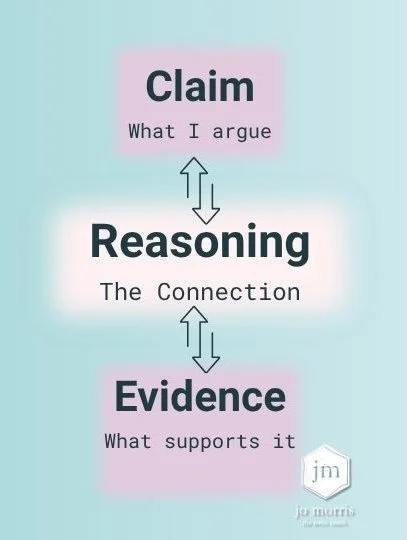
Evidence doesn't explain itself. Your reasoning is the bridge between what you've found and what you're arguing.
That third step is crucial.
And it's often the one that's missing, or at the very least, underdeveloped.
Students provide a quotation, a research finding or a statistic, assuming their reader will understand why it's relevant.
But the reader shouldn't have to do that work for you.
Let's go back to my wardrobe analogy for a moment.
If you took all your clothes off their hangers and tried to stand them upright on the floor, they'd collapse into a heap.
Evidence is rather like that. It doesn't stand up on its own.
You have to give it support.
Think of yourself as a detective examining the evidence. You're not simply presenting an object you've found. You're explaining what it tells us and why it matters to the case you're making.
This principle applies just as much to a postgraduate research assignment as it does to an NCEA English essay.
The evidence might look very different, but the intellectual work is the same.
The question that takes your thinking deeper: SO WHAT?
So how do you actually do that intellectual work?
How do you move from presenting evidence to explaining its significance?
One of the most useful questions I teach students to ask is wonderfully simple:
SO WHAT?
You've made a point and provided some evidence.
So what?
· What does that evidence actually demonstrate?
· Why is it significant?
· Could it be interpreted differently?
· Does it complicate your original argument?
· What are the wider implications?
These are the kinds of questions that take a paragraph beyond description and into genuine analysis.
I've developed that question - SO WHAT? - into a framework that gives students a series of prompts to work through when they're trying to deepen their thinking. If you've ever looked at a paragraph and known it needs more analysis, but couldn't work out what to add, try working through the SO WHAT? prompts. They're designed to help you ask the questions that take your reasoning further.
SO WHAT is the second part of my [November free download](INSERT LINK), alongside the framework for exploring possible arguments. The two go hand in hand – use ‘SPECTRUM’ do develop your thinking, and ‘SO WHAT’ to put it on a page.
The important thing is that these questions encourage you to examine the relationship between your claim and your evidence.
Sometimes they'll strengthen your original argument. Sometimes they'll reveal that your claim needs qualifying, or that the evidence doesn't support it quite as convincingly as you thought.
That's not a problem. That's exactly what critical thinking is supposed to do and often, it will transform an adequate paragraph into a genuinely insightful one.
Before you write your next assignment, try this
Take a paragraph from an assignment you've already written. Look at each sentence and ask yourself: Am I telling the reader something I know, or am I showing them what I think about it? Where have I introduced evidence? And where have I explained what that evidence actually demonstrates?
If you're finding that most of your sentences are reporting information, you've probably identified somewhere to begin.

What is each sentence in your paragraph actually doing? Try identifying your claims, evidence and reasoning.
Rather than starting with everything you know about the topic, take some time to work through the following steps.
1. Unpack the question.
Identify the instruction words. Are you being asked to describe, explain, analyse or evaluate? Look carefully at the boundaries of the question too. What exactly are you being asked to address?
2. Work out what kind of thinking is required.
How deeply do you need to engage with the material? Is the task asking you to demonstrate knowledge, explore relationships or make a judgement?
3. Explore possible positions.
Don't automatically settle on your first response. Consider other interpretations and test your assumptions before deciding what you want to argue.
4. Select your evidence carefully.
Remember the wardrobe. You don't need to use everything you know. Choose the material that is most relevant to the particular claim you're making.
5. Examine the evidence and explain its significance.
Don't assume a quotation or statistic speaks for itself. Show your reader how it supports your claim, then ask SO WHAT? to take your reasoning further.
And keep returning to the question. Your argument needs to answer the task you've actually been given, not simply demonstrate everything you've learned about the subject.
Knowing something is only the beginning
Academic success isn't just about knowing a whole lot of stuff. It's about what you do with all that accumulated knowledge.
There's a big leap between knowing something and genuinely understanding it. But there's another leap that I think isn’t always clear to students.
It's the leap from understanding something to being able to interpret it, develop a position and construct an argument that someone else can follow.
That requires deliberate thinking. It takes practice. And it's absolutely something that can be taught and learned.
So if you're sitting in front of an assignment or exam question, surrounded by notes and research, wondering why you can't seem to turn everything you know into the answer you're being asked for, perhaps the problem isn't how much you know.
Perhaps it's what you're trying to do with it.
And that's something we can work on.
If you're still struggling to see where your writing isn't doing what you want it to do, that's something we can work on together.
Often, we'll start with a piece of your own writing and the feedback you've received. We'll look at what the question is actually asking, what you're trying to argue, and where the connections between your ideas and evidence might need strengthening.
The aim isn't simply to improve that particular assignment. It's to help you understand what's happening in your writing, so you can recognise and address those problems yourself next time.
If that sounds like the kind of help you need, [get in touch](INSERT CONTACT LINK).
Because making writing make sense often begins with making sense of the thinking behind it.