

It’s all around us now. We drive to work. We check the mailbox. We turn on the TV or open Instagram— and there they are: election messages.
Political ads. Radio interviews. Headlines. Slogans. Social media posts. Conversations at work or book club.
By October in an election year, political language is everywhere. Even if you’re trying not to pay attention, sometimes you can’t escape it. It’s because we’re right in the thick of it that it’s a particularly good time to stop thinking only about what politicians are saying — and start looking at how they’re saying it.
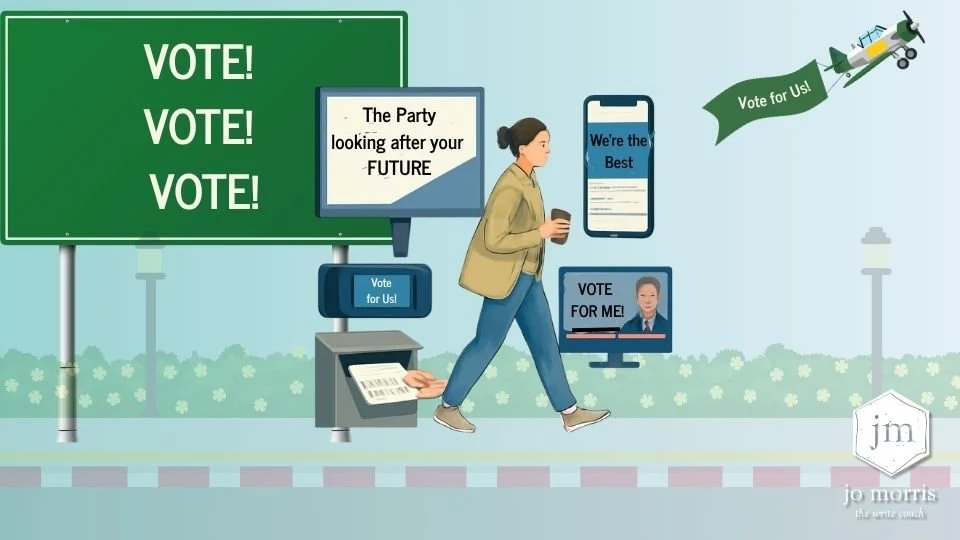
Election language is everywhere. Before deciding whether we agree with a message, we can stop and ask how its language is working.
One of the most useful things we learn at school
You learn an awful lot of stuff at school. But I think one of the biggest takeaways into adult life is learning how people communicate ideas to each other.
That happens across subjects. In science, you learn how people communicate what they’ve discovered. In Media Studies, you learn to understand the messages you encounter in the media. In History, you see what has happened when communication has gone well — or spectacularly awry. And in English, you might be handed a piece of text you’ve never seen before and asked to decode what it’s doing.
All of that is grist to the mill of understanding how people get ideas out of their own heads and into other people’s. Right now, in an election campaign, that’s a skill worth having.
So what if teachers — English teachers particularly, but actually teachers in all sorts of subjects — used the election campaign as reading and teaching material?
What if the rest of us took the same approach? When we encounter a political claim or slogan, our instinct is often to jump straight to:
Do I agree with this or not?
What if, temporarily, we postponed that judgement? What if, before asking Is it true? or Do I agree?, we asked:
What is the language doing?
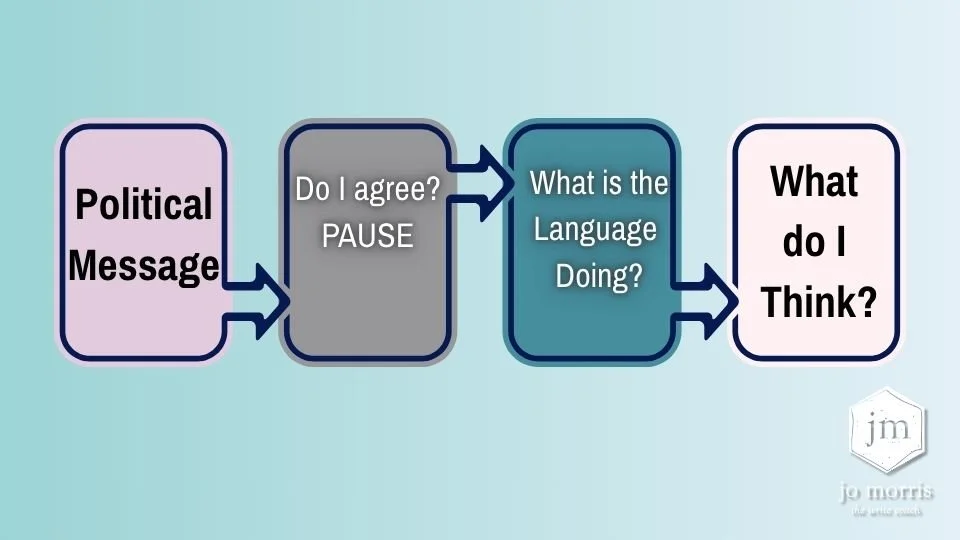
Instead of jumping straight to “Do I agree?”, pause and ask: “What is the language doing?”
Three levels of reading
There are three levels at which we can look at almost any piece of language.
Level 1: What does it say?
What is its literal meaning? What is happening on the surface?
Level 2: How does the language work?
This is where we start looking at language features: word choice, imagery, contrast, repetition, pronouns and verbs.
What has been put in the foreground? What has been left out? Why might one word have been chosen rather than another?
Level 3: What does that wording encourage me to think or feel?
This is where it gets really interesting.
Rather than claiming that we know exactly what the writer intended — because we don’t — we can examine the effects and meanings created by the language that is actually there.
· What does this wording draw my attention towards?
· What does it push into the background?
· What assumptions does it invite me to accept?
· What response does it encourage?
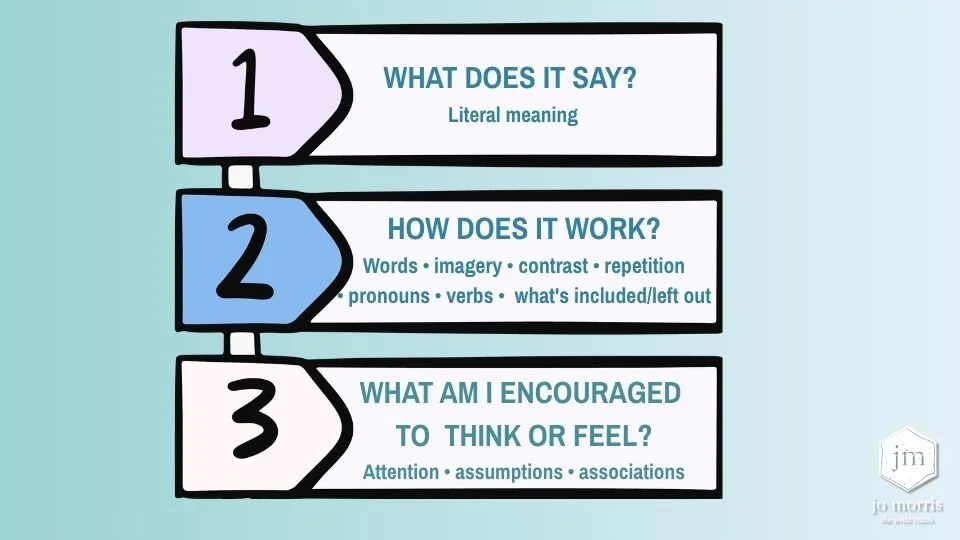
Three levels of reading: what does it say, how does the language work, and what does that wording encourage me to think or feel?
In an election campaign, those questions are particularly useful because political communication is designed to persuade.
Look at these two posts from Labour and National. Before we ask whether we agree with either of them, let's postpone that judgement for a moment and simply ask: what is the language doing?
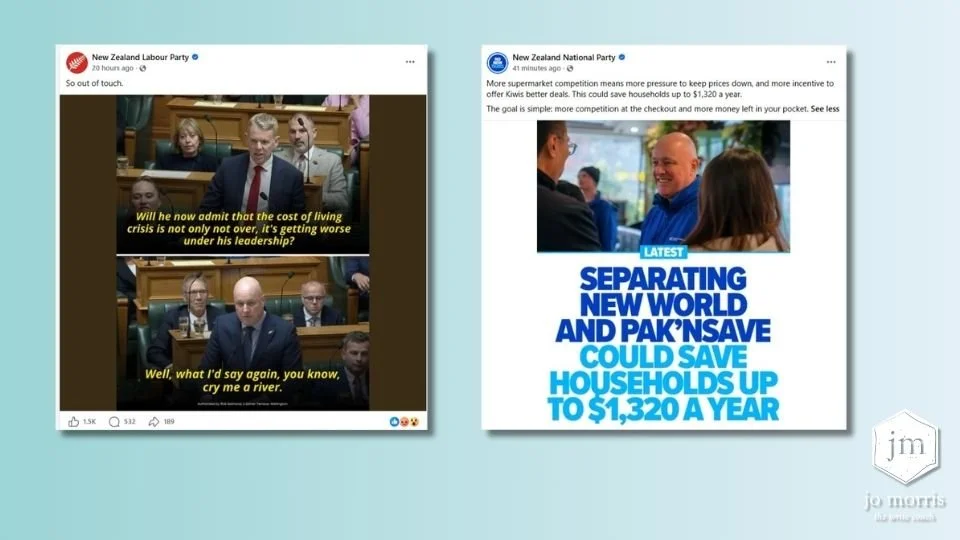
Two political messages doing different jobs. Before deciding whether you agree with either, what do you notice about the language choices?
Labour's post is built around contrast. Even its two-part layout puts one politician against another. The verb admit in Hipkins's question is interesting: you “admit” something that is already assumed to be true. Add crisis, getting worse and under his leadership, and the question itself contains an argument. The selected response is then juxtaposed against it. The post encourages us to judge the Government and its leader.
National's post works differently. It builds a chain: more competition → better deals → household savings. Notice the repetition of more, the reassuring claim that “the goal is simple”, and the move from an abstract idea — supermarket competition — to the very concrete “up to $1,320 a year” and “money left in your pocket”. It encourages us to see a policy proposal in terms of a direct personal benefit.
Neither analysis requires us to say whether Labour or National is right. We're doing something else first: noticing the choices each has made, and asking what those choices do.
Sometimes the smallest words are doing the most work
Often, it isn’t the big, noticeable political words that are the most interesting. It’s the little choices: a particular verb, a shift of pronouns or an almost unnoticed adjective. Or, perhaps, a phrase such as common sense that sounds so ordinary we might not stop to ask what it actually means — or what it implies about anyone who disagrees.
That’s why analysing language is more than hunting for techniques.
It’s about noticing choices:
· Why that word?
· Why that image?
· Why put those two ideas next to each other?
· Why repeat that phrase?
· What has been included — and what hasn’t?
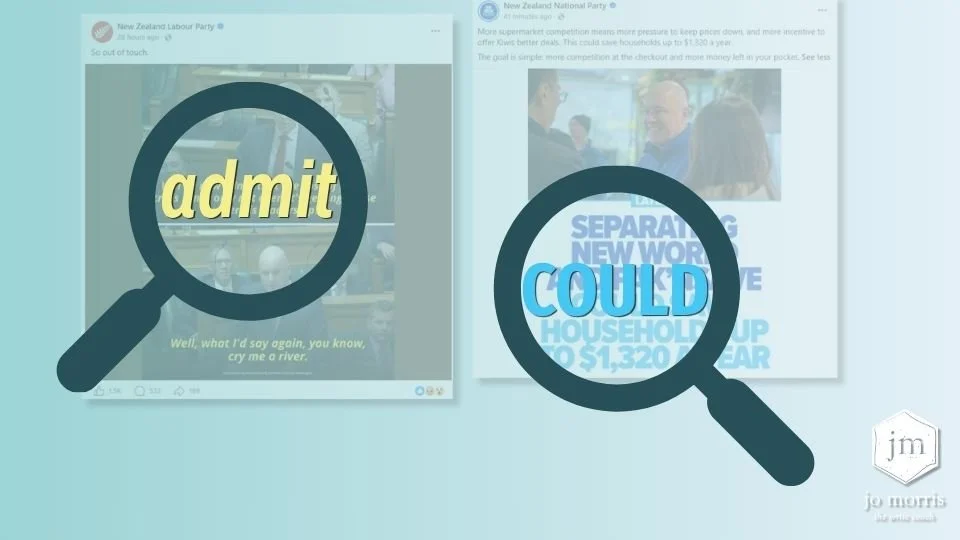
Small word. Big job. “Admit” builds an assumption into Labour’s question; “could” qualifies the certainty of National’s claim.
In the Labour post I just discussed, Admit is a small but powerful choice. We admit things that are already true but that we’ve been reluctant to acknowledge. So the verb quietly builds the proposition — that things are getting worse — into the question itself.
In the National post, I noticed ‘could’. Could is easy to skim past, particularly beside such a large and precise dollar figure. But it matters: could expresses possibility, not certainty. Compare “could save households $1,320” with “will save households $1,320”. One tiny word substantially changes the strength of the claim.
Which brings me to Election Bingo
This is really why I made my Election Bingo sheets. If you haven’t downloaded them yet, please do. They’re completely free.
They started as a slightly cheeky way of collecting the phrases, techniques and strategies that kept turning up in political communication.
But I’ve realised that they do something else: they make you notice.
You start seeing recurring phrases. Recurring techniques. Recurring strategies. You begin noticing how particular messages are framed and what response the language seems to invite.
The bingo element makes that noticing playful. But underneath the game, something much more useful is happening: you’re thinking about language.
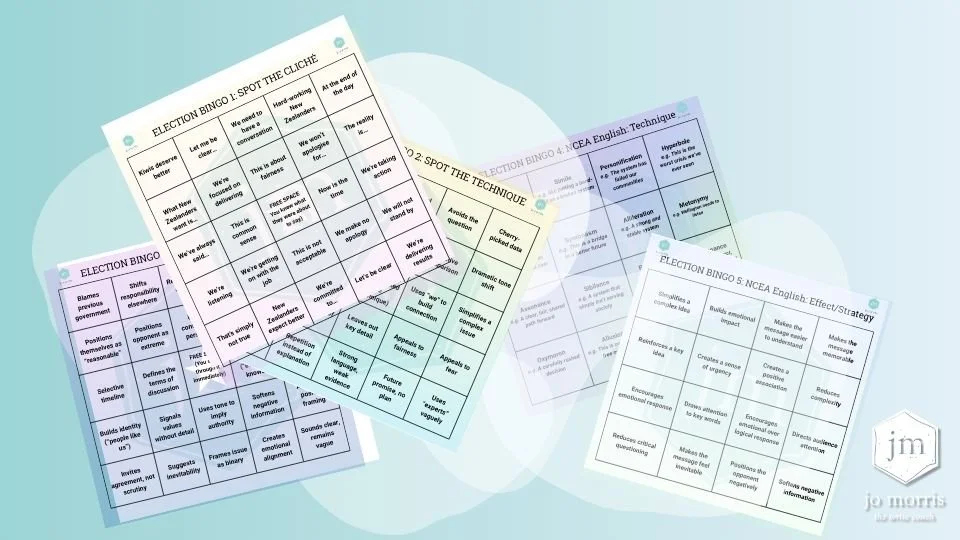
Election Bingo started as a game, but it’s really an invitation to notice the phrases, techniques and strategies that keep appearing in political communication.
An unfamiliar-text goldmine
I’ve been saying for a while that, for English teachers, an election campaign is an unfamiliar-text goldmine. As students prepare for their externals, they’re surrounded by real-life examples of language being used to influence an audience.
An election billboard. A social post. A campaign email. A headline. A speech. A slogan.
Put messages from different parties alongside one another and it becomes even more interesting, because students can examine how different communicators make different language choices.
Ask:
· What do you notice?
· Why that word?
· What does that contrast achieve?
· Who is the intended audience?
· What assumptions does this message make?
· What response does the wording invite?
It’s worth pointing out that neither you nor the students need to disclose their political views in order to analyse the language and see if it works.
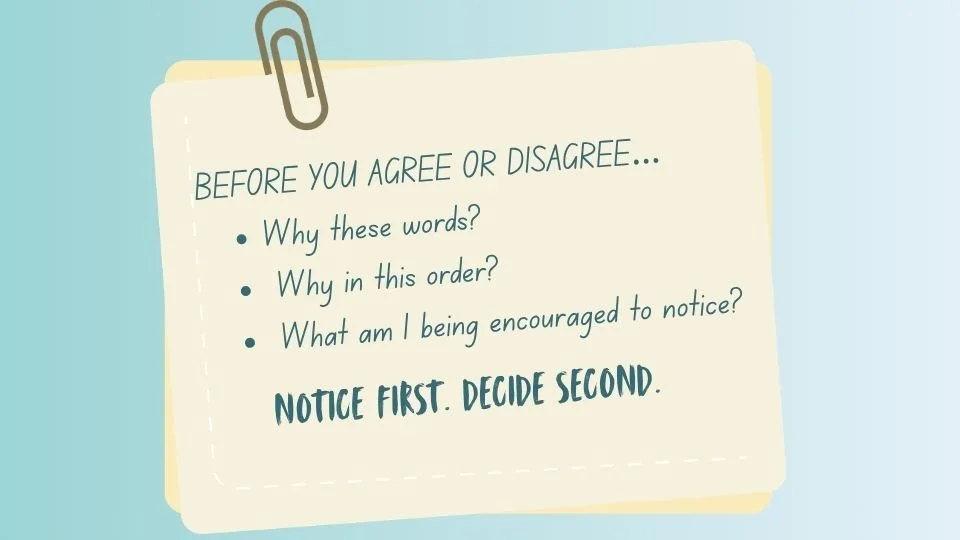
Before you agree or disagree: Why these words? Why in this order? What am I being encouraged to notice?
What about language where you agree?
This, I think, is where the exercise gets much harder. Critical thinking also means examining language when you agree with the underlying message.
It’s relatively easy to pick holes in the language of somebody whose politics you dislike. We’re already primed to be sceptical.
But can you examine language just as carefully when you already agree with it?
Can you spot assumptions in a message you support?
Conversely, can you recognise clever or effective use of language in a message you strongly disagree with?
That requires a much deeper kind of critical thinking.
Election Bingo isn’t really about bingo
The game is an invitation to notice: what’s being repeated, which techniques keep appearing and the words that seem almost too ordinary to analyse.
And then start asking why.
I’d love students — actually, I’d love all of us — to reach the position I’ve got to after years of teaching English. I can’t look at language passively anymore - I have to poke at it a bit:
· Why that word?
· What’s happening there?
· What am I being encouraged to notice?
· What have I not been encouraged to notice?
That skill won’t disappear when the election is over. It applies to advertising. News. Social media. Business communication. Novels. Emails. Speeches. Pretty much anywhere somebody is trying to get an idea out of their head and into yours.
Last month, I argued that we need to give young people more opportunities to think without rushing them towards the “right” answer.
An election campaign gives all of us an opportunity to practise.
Before deciding whether you agree with the next political message you see, spend a moment looking at the words.
· Why those words?
· Why in that order?
· What are they encouraging you to notice?
You might still end up at exactly the same conclusion.
But at least you’ll have had a think before you let the message do its work.